
AEO vs GEO vs SEO: What’s the Difference in 2026?
Search is changing rapidly. People are no longer relying only on traditional search engine results to find information, products, and services. With the growth of AI-powered search experiences and generative AI, businesses now need to think beyond traditional Search Engine Optimization (SEO).
This has led to the growing importance of Answer Engine Optimization (AEO) and Generative Engine Optimization (GEO).
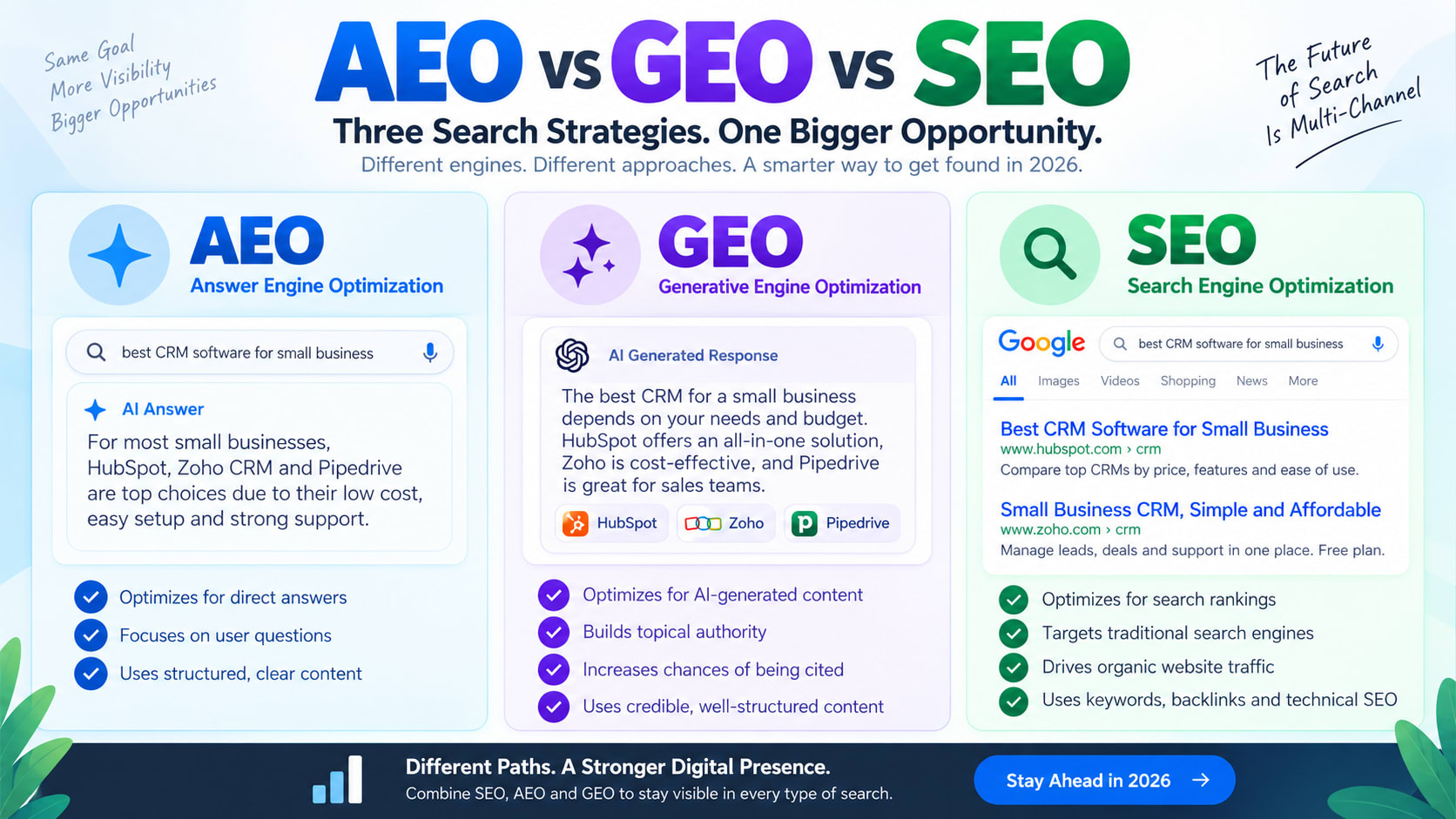
While SEO focuses primarily on improving visibility in traditional search results, AEO focuses on getting content selected as a direct answer to user questions. GEO goes a step further by optimizing content so that AI and generative search systems can understand, reference, and potentially cite a brand or website.
Understanding the differences between AEO vs GEO vs SEO can help businesses build a more effective search visibility strategy in 2026.
What Is SEO?
Search Engine Optimization (SEO) is the process of optimizing a website and its content to improve its visibility in traditional search engine results.
SEO typically focuses on factors such as:
Keyword targeting
Search intent
Website structure
Technical SEO
Page speed
Mobile usability
High-quality content
Internal linking
Backlinks
Website authority
For example, if someone searches for "best CRM software for small business," traditional SEO aims to help relevant pages appear higher in the organic search results.
A strong SEO strategy can generate consistent organic traffic over time and help businesses establish long-term authority in their industry.
What Is AEO?
Answer Engine Optimization (AEO) focuses on optimizing content so that search engines and answer-oriented systems can provide it as a direct answer to a user's question.
Instead of focusing only on ranking a webpage, AEO focuses on making information easy for search systems to understand, extract, and present.
For example, a user might search:
"What is the best CRM software for a small business?"
An answer-focused search experience may provide a summarized response instead of requiring the user to visit multiple websites.
How AEO Works
AEO strategies generally involve:
Answering specific questions clearly
Understanding search intent
Creating concise and useful responses
Using structured content
Organizing information with clear headings
Providing factual and verifiable information
Covering related questions
Keeping important information current
Content that directly addresses user questions has a better chance of being useful in answer-oriented search experiences.
What Is GEO?
Generative Engine Optimization (GEO) is an emerging approach focused on improving a brand's visibility within AI-generated search and answer experiences.
Generative AI systems can process information from multiple sources and produce a synthesized response. Instead of simply displaying a list of links, these systems may summarize information and reference sources that support their answers.
GEO therefore focuses on creating content that AI systems can understand, trust, synthesize, and potentially cite.
How GEO Works
A GEO strategy can include:
Publishing authoritative content
Providing original and useful information
Covering topics comprehensively
Building credibility around a subject
Using clear and quotable statements
Supporting claims with reliable information
Developing a consistent online presence
Earning mentions and references from relevant websites
The goal is not simply to rank for a keyword but to increase the likelihood that a brand's information becomes part of an AI-generated response.
AEO vs GEO vs SEO: Key Differences
Although SEO, AEO, and GEO have different objectives, they are closely connected.
| SEO | AEO | GEO |
|---|---|---|
| Focuses on search rankings | Focuses on direct answers | Focuses on AI-generated responses |
| Targets traditional search engines | Targets answer-oriented search | Targets generative AI experiences |
| Drives organic website traffic | Provides quick answers | Builds visibility within AI answers |
| Uses keywords and search intent | Uses questions and structured answers | Uses authoritative, contextual content |
| Backlinks and technical SEO are important | Clarity and answerability are important | Authority, context, and credibility are important |
| Long-term organic visibility | Answer visibility | AI search visibility |
The three strategies should not necessarily be treated as competing approaches. Instead, businesses can combine them as part of a broader search visibility strategy.
Why AEO, GEO and SEO Matter in 2026
Search behavior is becoming more conversational and increasingly influenced by artificial intelligence.
Users may ask complete questions rather than entering short keyword phrases. They may also use AI-powered search experiences to compare products, research businesses, understand complex topics, and make purchasing decisions.
This creates new opportunities for businesses.
A company that only focuses on traditional rankings may miss opportunities to appear in answer-based and AI-generated experiences.
For this reason, modern search strategies need to consider multiple forms of discovery.
How SEO, AEO and GEO Work Together
The best approach is not to completely replace SEO with AEO or GEO.
Instead, businesses can build a strategy where all three support each other.
1. Start With Strong SEO
Your website needs a solid technical and content foundation.
This includes:
Fast-loading pages
Mobile-friendly design
Crawlable website architecture
Proper internal linking
Relevant keywords
High-quality content
Strong user experience
Without a healthy website foundation, other optimization efforts may also become less effective.
2. Create Content That Answers Questions
Once the SEO foundation is established, create content around real questions users ask.
For example, instead of creating a page that only targets:
"Website development company India"
you can also answer questions such as:
What does a website development company do?
How much does website development cost in India?
How long does it take to build a business website?
What technologies are used for website development?
How do I choose a website development company?
This makes the content more useful for both users and answer-oriented search experiences.
3. Build Topical Authority
GEO requires more than publishing random articles.
Businesses should develop comprehensive coverage around their core topics.
For example, a software development company could create content covering:
Software development
Mobile app development
Web application development
Custom software development
AI development
Cloud development
Software development costs
Software development processes
Technology comparisons
Industry-specific software solutions
This helps establish a consistent presence around relevant subjects.
The Role of Content in AEO and GEO
Content remains one of the most important elements of modern search optimization.
However, simply publishing large amounts of content is not enough.
Content should be:
Clear: Users should quickly understand the answer.
Useful: It should solve a genuine problem.
Accurate: Claims should be factual and supported where appropriate.
Well-structured: Headings, lists, tables, and concise sections make information easier to understand.
Relevant: Content should match the user's search intent.
Comprehensive: Important aspects of the topic should be covered without unnecessary repetition.
For AEO and GEO, content should also contain statements that can be easily understood when separated from the surrounding page.
Does SEO Still Matter With AI Search?
Absolutely.
The emergence of AI search does not mean traditional SEO is dead.
Search engines still rely heavily on websites, content, links, technical accessibility, relevance, and authority to discover and understand information.
SEO continues to provide the foundation for online visibility.
AEO and GEO should therefore be viewed as extensions of a modern search strategy rather than replacements for SEO.
AEO vs GEO: What Is the Main Difference?
AEO and GEO are often confused because both involve AI-driven or answer-focused search experiences.
The key difference is the optimization objective.
AEO focuses on getting content recognized as a useful answer to a specific question.
GEO focuses on increasing the likelihood that a brand or its information is represented, referenced, or cited in generative AI responses.
For example, AEO may focus heavily on answering:
"What is custom software development?"
GEO may focus more broadly on establishing the company as a credible source across the topic of custom software development.
In practice, there is significant overlap between the two.
How to Optimize Your Website for SEO, AEO and GEO
Businesses can use a combined approach to improve their search visibility.
Use Search Intent
Understand what users actually want when they search for a topic.
A keyword may have informational, commercial, navigational, or transactional intent.
Your content should satisfy that intent rather than simply repeating the keyword.
Answer Questions Directly
Place clear answers near relevant headings.
Avoid making users read several paragraphs before finding the basic answer.
Use Clear Headings
Organize content using descriptive H2 and H3 headings.
This makes the content easier for users and search systems to understand.
Add Relevant Structured Data
Where applicable, use appropriate structured data to help search engines understand the content and entities on a page.
Structured data should accurately represent the visible content and should not be used to manipulate search results.
Demonstrate Expertise
Include useful examples, original insights, data, case studies, author information, and credible references where appropriate.
The goal is to create content that people can genuinely trust and use.
Keep Content Updated
Industries, technologies, pricing, regulations, and search experiences change over time.
Regularly reviewing important pages can help keep information accurate and relevant.
Build Digital Authority
Relevant mentions, citations, backlinks, partnerships, reviews, and other credible references can contribute to a brand's overall online presence.
For GEO in particular, being consistently represented across trustworthy sources can be valuable.
Common Mistakes in AEO and GEO
Businesses entering AI-focused search optimization often make several mistakes.
Creating Content Only for Keywords
Keyword optimization is still useful, but content written only around keyword density often provides little value.
Focus on the user's actual question and intent.
Publishing Low-Quality AI Content
AI can help with research, ideation, and content production, but automatically generated content without meaningful editing, expertise, or original value can create poor user experiences.
Ignoring Traditional SEO
Focusing exclusively on GEO while neglecting technical SEO, website performance, indexing, and content quality is not a sustainable strategy.
Making Unsupported Claims
AI systems and users benefit from information that is accurate, specific, and trustworthy.
Support important claims with credible evidence whenever appropriate.
Chasing Every New AI Platform
Search technology is evolving quickly. Instead of optimizing for every new platform individually, focus on creating a strong, authoritative, technically accessible web presence.
Which Strategy Should Your Business Choose?
The answer depends on your business goals, but for most businesses, the best approach is SEO + AEO + GEO.
Choose SEO if:
You want consistent organic traffic.
You need better traditional search rankings.
You want to build long-term website authority.
You want to target commercial keywords.
Focus on AEO if:
Your customers frequently ask questions.
You want your content to provide direct answers.
You operate in an information-heavy industry.
You want to target conversational search behavior.
Invest in GEO if:
Your audience increasingly uses AI search.
You want greater visibility in AI-generated answers.
You want to strengthen your brand's authority.
Your business depends on being discovered during research and comparison.
For most modern businesses, combining all three provides a more comprehensive search visibility strategy.
The Future of Search: From Rankings to Visibility
Traditional SEO often asks:
"Where does my website rank?"
Modern search optimization increasingly asks:
"Where is my brand being discovered, mentioned, recommended, and referenced?"
This is an important shift.
A business may appear in a traditional search result, an AI-generated answer, a featured answer, a conversational search response, or multiple forms of search simultaneously.
As search continues to evolve, businesses should focus on becoming a reliable source of information rather than optimizing exclusively for one type of search result.
Final Thoughts
SEO, AEO, and GEO are three important components of modern search visibility.
SEO helps websites compete in traditional organic search. AEO focuses on providing direct answers to user questions, while GEO focuses on improving visibility within generative AI experiences.
Rather than choosing one approach, businesses should build a strategy that combines the strengths of all three.
A strong technical SEO foundation, helpful question-focused content, topical authority, credible information, and consistent online presence can help businesses remain competitive as search continues to evolve in 2026 and beyond.
The future of search isn't just about ranking higher—it is about becoming the source users and AI systems can trust.