

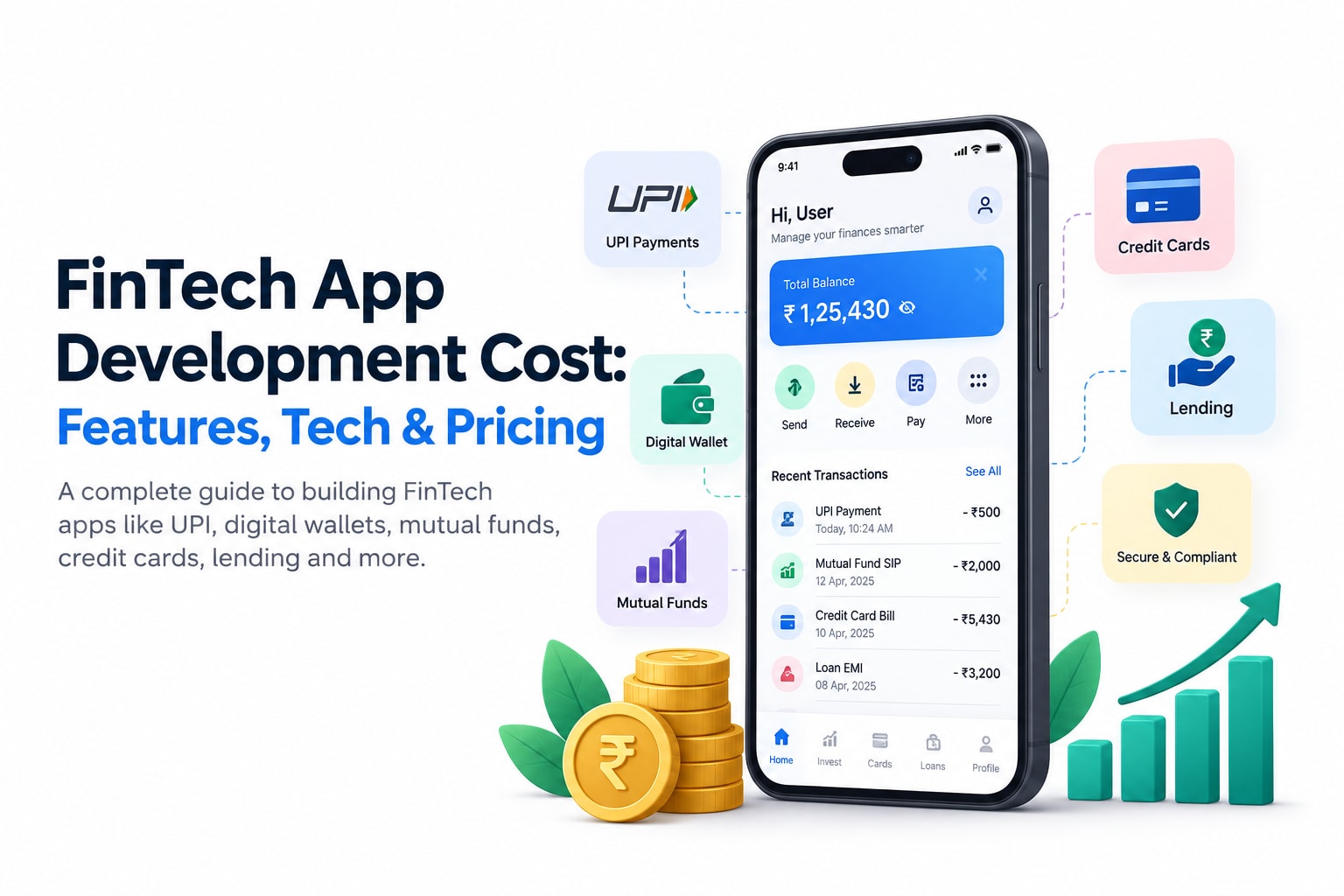
FinTech App Development Cost: Features, Tech & Pricing
The financial technology industry is transforming the way people manage money, make payments, invest, borrow, and access financial services. From UPI payment applications and digital wallets to mutual fund platforms, credit card applications, lending platforms, and investment solutions, businesses are increasingly investing in fintech software development.
One of the most common questions businesses have before starting a fintech project is: How much does it cost to develop a FinTech app?
The answer depends on several factors, including the type of fintech application, features, technology stack, third-party API integrations, security requirements, platform selection, development team, and regulatory requirements.
In this guide, we will explain the FinTech app development cost, essential features, technology stack, development process, integrations, security requirements, and factors that influence the overall development budget.
What Is FinTech App Development?
FinTech app development is the process of designing and developing digital platforms that provide financial services through mobile applications, web applications, and software platforms.
A fintech application can be developed for different financial services, including:
UPI and digital payments
Digital wallets
Credit cards
Personal and business loans
Mutual fund investments
Stock and investment platforms
Insurance
Wealth management
Expense management
Payment processing
Banking solutions
Financial management
Lending platforms
Depending on the business model, a fintech product can be developed as a mobile app, web platform, SaaS solution, payment platform, financial dashboard, or complete fintech ecosystem.
How Much Does It Cost to Develop a FinTech App?
The cost of fintech app development depends on the complexity and functionality of the application.
A basic FinTech MVP can cost approximately $15,000 to $30,000, while a medium-complexity fintech platform can cost around $30,000 to $80,000.
Advanced investment, lending, payment, banking, or financial platforms can cost $80,000 to $150,000 or more, depending on integrations, security, scalability, and regulatory requirements.
Estimated FinTech App Development Cost
| Type of FinTech App | Estimated Cost |
|---|---|
| Basic FinTech App | $15,000 – $30,000 |
| Digital Wallet App | $25,000 – $60,000 |
| UPI & Payment App | $30,000 – $80,000+ |
| Lending Platform | $35,000 – $100,000+ |
| Mutual Fund Platform | $40,000 – $120,000+ |
| Credit Card App | $40,000 – $100,000+ |
| Investment Platform | $40,000 – $120,000+ |
| Enterprise FinTech Platform | $100,000 – $300,000+ |
These figures are indicative estimates. The final cost depends on the exact requirements, number of platforms, integrations, security architecture, development location, and project complexity.
Major Factors That Affect FinTech App Development Cost
Several factors determine the final cost of developing a fintech application.
1. Type of FinTech Application
The type of financial application is one of the biggest factors affecting development cost.
For example, a basic expense management application may only require user accounts, expense tracking, reports, and notifications.
A UPI payment application may require payment processing, transaction management, QR payments, payment status tracking, notifications, fraud monitoring, and multiple integrations.
Similarly, a mutual fund investment platform may require KYC verification, investment APIs, SIP management, portfolio tracking, transaction processing, statements, and financial reporting.
The more complex the financial product, the higher the development cost.
2. Number of Platforms
The cost also depends on where you want to launch your fintech application.
You may need:
Android application
iOS application
Web application
Admin panel
Customer dashboard
Partner dashboard
Merchant dashboard
Developing a fintech application for multiple platforms increases development time and overall cost.
3. UI/UX Design
Fintech applications deal with sensitive financial information, so the user interface needs to be simple, intuitive, and trustworthy.
A professional fintech UI/UX design may include:
User dashboard
Account overview
Transaction screens
Payment screens
Investment dashboard
Charts and analytics
Financial reports
KYC screens
Profile management
Notifications
Security settings
A well-designed interface can make complex financial information easier for users to understand.
Essential Features of a FinTech App
A modern fintech application can include a wide range of features depending on its business model.
User Registration and Login
Users can register using:
Mobile number
Email address
OTP verification
Password
Multi-factor authentication
Secure authentication is particularly important for financial applications.
KYC Verification
KYC is an important part of many financial services.
Depending on the business model and applicable requirements, a fintech application may integrate identity and document verification services.
Possible functionality includes:
Identity verification
Document verification
PAN verification
Address verification
Face verification
KYC status tracking
User Dashboard
A personalized dashboard can display:
Account balance
Transactions
Investments
Payments
Credit information
Loan details
Financial reports
Notifications
Transaction Management
The application can maintain a complete record of financial transactions.
Users may be able to:
View transactions
Search transactions
Filter transactions
Download statements
Track payment status
View refunds
Download receipts
Notifications
Fintech applications can send notifications for:
Successful transactions
Failed payments
Payment reminders
Investment updates
Loan repayments
Card transactions
Security alerts
UPI Payment App Development
UPI has become an important part of India's digital payments ecosystem.
A UPI-focused fintech application can include features such as:
UPI payments
UPI ID management
QR code payments
Payment collection
Transaction history
Payment status
Refund management
Merchant payments
Notifications
Settlement management
The exact architecture, integrations, and compliance requirements depend on the type of UPI product and the entities involved.
Digital Wallet App Development
A digital wallet allows users to store and manage money digitally and perform financial transactions through an application.
Common digital wallet features include:
Wallet balance
Add money
Send money
Receive money
Bank transfers
Transaction history
Refunds
Payment notifications
Wallet ledger
User verification
A wallet application also requires strong security and transaction monitoring.
Mutual Fund App Development
Investment platforms are another major category of fintech applications.
A mutual fund application can allow users to:
Discover mutual funds
Compare funds
Start SIPs
Make lump-sum investments
Track portfolios
Monitor returns
View transaction history
Download statements
Manage investments
Receive investment notifications
A complete mutual fund platform may require integration with appropriate financial data, KYC, transaction, and investment infrastructure.
Credit Card App Development
A credit card management application can provide users with complete control over their cards and transactions.
Important features may include:
Credit card onboarding
KYC verification
Credit limit information
Available credit
Transaction history
Bill generation
Bill payments
EMI conversion
Reward points
Cashback information
Payment reminders
Card controls
Fraud alerts
Advanced credit card platforms can also provide spending analytics and personalized financial insights.
Lending App Development
Digital lending is another growing fintech segment.
A lending application can include:
User registration
KYC verification
Loan application
Loan eligibility
Document upload
Credit assessment
Approval workflow
Loan disbursement
EMI calculation
Repayment schedule
Online repayment
Collection management
Notifications
Admin dashboard
The technology architecture should be designed according to the lending model and applicable legal and regulatory requirements.
Payment Gateway Integration
Payment gateway integration is required for many fintech applications.
Depending on the business model, a fintech application may support:
Credit card payments
Debit card payments
UPI
Net banking
Wallet payments
Recurring payments
Payment links
Refunds
Settlement tracking
Payment gateway integration allows businesses to process payments securely without building every payment infrastructure component from scratch.
FinTech API Integration
Third-party APIs play an important role in modern fintech development.
Common fintech API integrations include:
Payment APIs
UPI APIs
Banking APIs
KYC APIs
Identity verification APIs
Credit bureau APIs
Mutual fund APIs
Investment APIs
SMS APIs
Email APIs
Notification APIs
Fraud detection APIs
Accounting APIs
The number and complexity of integrations can have a significant impact on the overall fintech app development cost.
FinTech Technology Stack
Choosing the right technology stack is important for building a secure and scalable fintech platform.
Frontend Development
Popular technologies include:
React
Next.js
Flutter
React Native
Kotlin
Swift
Backend Development
Common backend technologies include:
Node.js
Python
Java
PHP
.NET
Database
Depending on the application requirements, developers may use:
PostgreSQL
MySQL
MongoDB
Redis
Cloud Infrastructure
Cloud platforms such as AWS, Microsoft Azure, and Google Cloud can be used for:
Application hosting
Database management
File storage
Monitoring
Backup
Security
Scalability
FinTech App Security
Security is one of the most important aspects of fintech software development.
A fintech application may require:
Data encryption
Secure authentication
Multi-factor authentication
OTP verification
Role-based access control
API security
Secure database architecture
Audit logs
Fraud monitoring
Session management
Backup and disaster recovery
Security monitoring
For applications that process payment card data, applicable PCI DSS requirements may also need to be considered.
Security requirements should be defined during the architecture and planning stage rather than added after development.
AI in FinTech App Development
Artificial intelligence is creating new opportunities in financial technology.
AI can be used for several fintech use cases, including:
Fraud Detection
AI and machine learning models can analyze transaction patterns and identify potentially suspicious activity.
AI Financial Assistant
An AI-powered assistant can help users understand their transactions, spending patterns, account information, and financial reports.
Personalized Financial Insights
AI can analyze user activity and provide personalized insights based on the application's functionality and applicable requirements.
Risk Analysis
Machine learning can assist with data analysis and risk assessment in appropriate financial applications.
Blockchain in FinTech
Blockchain technology can be useful for selected fintech use cases.
Potential applications include:
Digital assets
Tokenization
Smart contracts
Transaction records
Cross-border settlement
Digital identity
However, blockchain is not required for every fintech application. The technology should be selected according to the actual business requirements, technical architecture, and regulatory environment.
FinTech App Development Process
A successful fintech application requires a structured development process.
Step 1: Business Analysis
The development team first understands:
Business model
Target audience
Financial products
User journeys
Required integrations
Security requirements
Compliance requirements
Step 2: UI/UX Design
The design team creates:
Wireframes
User flows
Interface designs
Prototypes
Step 3: Backend Development
The backend handles:
APIs
Authentication
Business logic
Transactions
Database
Financial calculations
Notifications
Step 4: Mobile and Web Development
The frontend application connects users with the backend financial services.
Step 5: API Integration
Required payment, banking, KYC, investment, notification, and other third-party APIs are integrated.
Step 6: Testing and Security
The application is tested for:
Functional errors
Security vulnerabilities
API failures
Performance
Transaction processing
Authentication
Data validation
Step 7: Deployment
After testing, the application can be deployed to the required cloud infrastructure and application stores.
Step 8: Maintenance
Fintech applications require continuous maintenance, including:
Security updates
Bug fixes
API updates
Performance optimization
Infrastructure monitoring
Feature improvements
FinTech MVP Development Cost
Businesses that want to validate a fintech idea can start with a Minimum Viable Product.
A fintech MVP focuses on the most important features required to launch the product and test the business model.
For example, a digital wallet MVP may include:
User registration
KYC
Wallet
Add money
Send money
Transaction history
Notifications
Admin panel
A basic fintech MVP can cost approximately $15,000 to $40,000, depending on the features, integrations, platforms, and complexity.
Once the MVP is validated, additional features can be introduced in later development phases.
How to Reduce FinTech App Development Cost
Businesses can control development costs by following a phased development strategy.
Start With an MVP
Instead of developing every feature at once, launch the core product first.
Prioritize Features
Divide features into:
Must Have → Should Have → Advanced
This helps control the initial development budget.
Use Suitable APIs
Third-party APIs can reduce the time and resources required to build certain financial services from scratch.
Choose the Right Technology
The technology stack should be selected according to performance, scalability, security, development speed, and long-term maintenance requirements.
Build a Scalable Architecture
A scalable architecture makes it easier to introduce new financial products and features in the future.
FinTech App Development Cost Breakdown
The development budget can generally be divided across different stages of the project.
| Development Stage | Approximate Cost Share |
|---|---|
| Business Analysis | 5% – 10% |
| UI/UX Design | 10% – 15% |
| Frontend Development | 15% – 20% |
| Backend Development | 20% – 30% |
| API Integrations | 10% – 20% |
| Testing & Security | 10% – 15% |
| Deployment | 5% – 10% |
The actual cost distribution depends on the project scope and technical requirements.
How Long Does It Take to Build a FinTech App?
The development timeline depends on the complexity of the product.
A basic fintech MVP may take several weeks, while a feature-rich fintech platform can take several months.
The timeline can increase when the project requires:
Multiple mobile platforms
Web applications
Complex backend architecture
Multiple APIs
KYC integration
Payment integration
Investment APIs
Advanced security
AI features
Complex admin dashboards
Extensive testing
A detailed project plan should be prepared after finalizing the features and integrations.
Why Choose a Professional FinTech Development Company?
Building a fintech application requires expertise in software development, API integration, security, cloud infrastructure, user experience, and financial technology.
A professional fintech development company can help businesses with:
FinTech product development
Mobile app development
Web application development
Backend development
UI/UX design
Payment gateway integration
UPI integration
KYC integration
Investment API integration
Digital wallet development
Lending platform development
Credit card application development
Cloud deployment
Security implementation
Testing and maintenance
The development approach should be customized according to the business model, target market, financial product, technology requirements, and applicable regulations.
Conclusion
The FinTech app development cost depends on the type of application, features, platforms, integrations, technology stack, security requirements, and regulatory considerations.
A simple fintech MVP can be developed with a relatively smaller investment, while complex platforms for UPI payments, digital wallets, mutual funds, credit cards, lending, investments, or banking services require a larger development budget and more advanced infrastructure.
The best approach is to start by defining the business model, identifying the core features, selecting the required integrations, and designing a secure and scalable architecture.
Whether you are planning to build a UPI payment app, mutual fund investment platform, digital wallet, credit card application, lending platform, investment app, or custom fintech software, a clearly defined development strategy can help you control costs and build a product that is ready to scale.
Frequently Asked Questions
How much does it cost to develop a FinTech app?
FinTech app development can cost approximately $15,000 to $30,000 for a basic application and $100,000 or more for complex financial platforms. The final cost depends on features, integrations, security, platforms, and project complexity.
How much does it cost to build a UPI app?
The cost depends on the required UPI functionality, integrations, transaction processing, security, user management, and applicable regulatory requirements.
How much does it cost to build a mutual fund app?
A mutual fund platform can cost approximately $40,000 to $120,000 or more depending on KYC, investment APIs, SIP functionality, portfolio management, transactions, reporting, and platform complexity.
How much does it cost to develop a digital wallet?
A digital wallet can cost approximately $25,000 to $60,000 depending on wallet functionality, payment integrations, KYC, transaction management, security, and platforms.
How long does it take to develop a fintech app?
A basic fintech MVP may take several weeks, while a complex fintech platform can require several months depending on the number of features, integrations, platforms, testing, and security requirements.
Can AI be integrated into a fintech application?
Yes. AI can be integrated for use cases such as fraud detection, transaction analysis, customer support, financial insights, automation, and risk analysis where appropriate.
What technology is used for FinTech app development?
Common technologies include React, Next.js, Flutter, React Native, Node.js, Python, Java, PostgreSQL, MySQL, MongoDB, AWS, Microsoft Azure, and Google Cloud.
What are the most popular types of fintech applications?
Popular fintech application categories include UPI payment apps, digital wallets, investment apps, mutual fund platforms, credit card apps, lending platforms, banking applications, insurance platforms, and financial management applications.