
Mobile Application Development Services
As technology continues to evolve, mobile application development is also changing. Businesses are now looking for applications that are faster, more secure, personalized, and capable of integrating advanced technologies such as artificial intelligence and cloud computing.
Why Mobile Application Development Is Important for Businesses
A mobile application gives businesses a direct way to interact with their customers. Instead of depending entirely on a website or third-party platform, companies can provide services through an application designed specifically for their audience.A well-developed mobile application can help businesses:
Improve customer engagement
Provide faster access to products and services
Automate repetitive business processes
Increase customer retention
Offer personalized experiences
Improve internal productivity
Create new revenue opportunities
For this reason, investing in professional mobile application development services has become an important part of digital transformation for many businesses.
Top Mobile Application Development Trends in 2026
1. AI-Powered Mobile Applications
Artificial intelligence is becoming one of the biggest trends in application development. Businesses are integrating AI into mobile apps to provide smarter recommendations, automated customer support, intelligent search, personalized content, and workflow automation.For example, an e-commerce application can use AI to recommend products based on customer behavior, while a business application can use AI to automate routine tasks and analyze large amounts of data.
This is making AI-powered mobile app development increasingly valuable for businesses looking to create more intelligent digital experiences.
2. Cross-Platform Mobile App Development
Businesses often want their applications to work on both Android and iOS without developing completely separate applications.
Cross-platform development can help companies reduce development time and simplify maintenance while delivering a consistent experience across multiple devices.
The right technology depends on the application's requirements, performance expectations, integrations, and long-term goals.
3. Focus on User Experience
Having a mobile application is not enough. Users expect applications to be simple, fast, attractive, and easy to navigate.
Modern mobile application development therefore puts significant focus on UI and UX design. A well-designed application should allow users to complete important tasks with minimum effort.
Simple navigation, fast loading times, clear layouts, and responsive interfaces can make a significant difference in user engagement.
4. Better Mobile Application Security
Security has become a major consideration for businesses developing mobile applications.
Applications often handle sensitive information such as customer details, payment information, business data, and login credentials. Developers therefore need to consider security throughout the development process.
Secure authentication, encrypted data, protected APIs, secure storage, access controls, and regular security testing can help create a safer application environment.
5. Cloud-Based Applications
Cloud technology allows mobile applications to connect with scalable servers, databases, APIs, analytics systems, and other business platforms.
A cloud-based architecture can make it easier for businesses to manage growing numbers of users and transactions. It can also support integrations with existing business systems.
This makes cloud technology an important component of modern enterprise mobile application development.
Custom Mobile App Development for Businesses
Every business has different requirements. A restaurant, logistics company, healthcare provider, e-commerce business, and financial organization may all require completely different application features.
This is where custom mobile app development can provide an advantage.
Instead of changing business processes to fit an existing application, businesses can develop an application around their specific requirements.
Custom applications can include:
Customer portals
Booking and appointment systems
E-commerce functionality
Payment integration
Employee management
CRM integration
Inventory management
Real-time notifications
Analytics dashboards
Third-party API integrations
A custom approach also gives businesses greater flexibility to add new features as their requirements change.
How to Choose the Right Mobile Application Development Company
Choosing the right development partner can have a significant impact on the success of a mobile application.
Before selecting a mobile application development company, businesses should consider the team's technical expertise, previous projects, development process, communication, security practices, and post-launch support.
It is also important to understand how the company approaches planning and development. A professional team should first understand the business objectives and then recommend the appropriate technology and development strategy.
Businesses should look for a development partner that can provide:
Android and iOS development
UI/UX design
Backend development
API integration
Cloud integration
Application testing
Security implementation
App deployment
Maintenance and support
Mobile Application Development Process
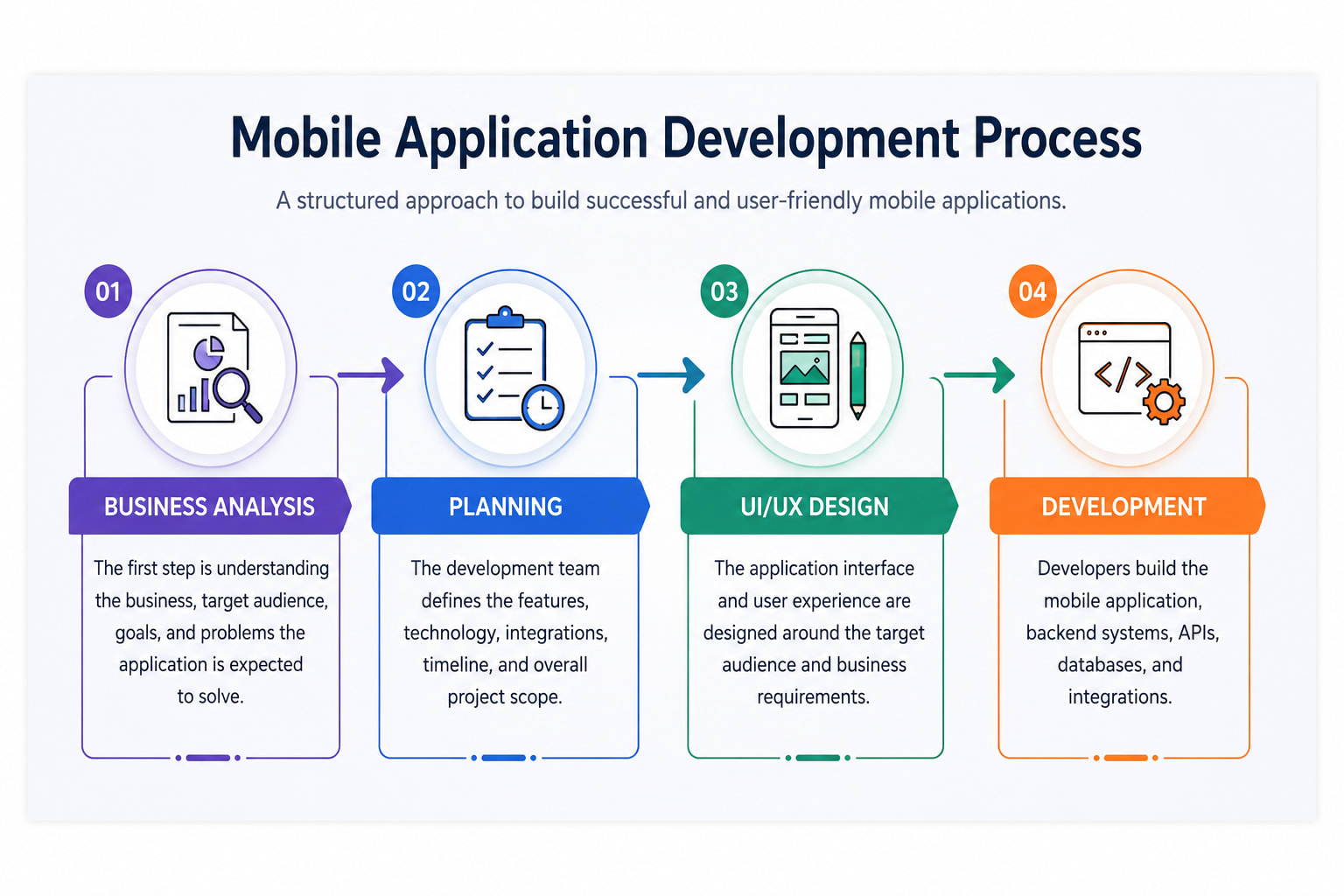
A successful application requires proper planning before development begins. A typical development process includes several stages.
Business Analysis
The first step is understanding the business, target audience, goals, and problems the application is expected to solve.
Planning
The development team defines the features, technology, integrations, timeline, and overall project scope.
UI/UX Design
The application interface and user experience are designed around the target audience and business requirements.
Development
Developers build the mobile application, backend systems, APIs, databases, and integrations.
Testing
The application is tested for functionality, performance, compatibility, usability, and security.
Deployment
After successful testing, the application is prepared for release through the relevant app stores and production infrastructure.
Maintenance
Mobile application development does not end after launch. Regular updates, bug fixes, security improvements, performance optimization, and new features may be required as the business grows.
How Much Does Mobile App Development Cost?
The cost of developing a mobile application depends on several factors. There is no single price that applies to every project.
The overall cost can be influenced by:
Number of features
Android and iOS requirements
UI/UX complexity
Backend development
Third-party integrations
Payment gateway integration
Security requirements
Cloud infrastructure
Testing requirements
Ongoing maintenance
For this reason, businesses should first define their requirements and then obtain a development estimate based on the actual scope of the project.
What Is the Future of Mobile Application Development?
The future of mobile applications is moving toward smarter, more connected, and personalized experiences.
AI, cloud computing, automation, advanced analytics, and improved security will continue to influence how applications are designed and developed.
Businesses are also moving beyond simple applications toward platforms that can automate processes, connect different systems, and provide personalized experiences to users.
This means companies investing in mobile application development should think beyond the initial launch. Applications should be designed with scalability, security, performance, and future improvements in mind.
Final Thoughts
Mobile applications have become much more than digital versions of websites. They can help businesses improve customer engagement, automate operations, deliver personalized services, and create new digital revenue channels.
Whether you need a simple customer-facing application or a complex enterprise solution, choosing the right mobile application development services can make a significant difference.
A successful mobile app starts with a clear business objective, a strong user experience, the right technology, and a development team that understands both your technical and business requirements.